
Paul Harvey begins Howard Thurman and the Disinherited: A Religious Biography, his biography of the African American philosopher, theologian, educator, and civil rights leader, with the following description:
As a boy growing up in a small black community situated by Dayton Beach, Florida, Howard Thurman loved nature. He learned from it lessons that shaped his life. . . . Thurman loved to sit near the ocean at night; it gave him a sense of “timelessness, of existing beyond the reach of the ebb and flow of circumstances.” The periodic storms that lashed the coastline thrilled him . . . His experience with the storms gave him . . . an “overriding immunity against most of the pain with which I would have to deal in the years ahead when the ocean was only a memory.” (HT, 1)
One of Thurman’s deepest experiences of personal pain came early in life when as a seven year old attending the funeral of his father Saul Thurman, an agnostic and free thinker, he heard the minister declare that the dead man’s soul was beyond salvation. ‘”I listened with wonderment, then anger, and finally mounting rage,” Thurman said, as his father was “preached into hell.”‘(HT, 12)
Seeking comfort and support to help him deal with his rage at the minister (and the increasing racism he experienced growing up), Thurman found them in nature. Harvey writes:
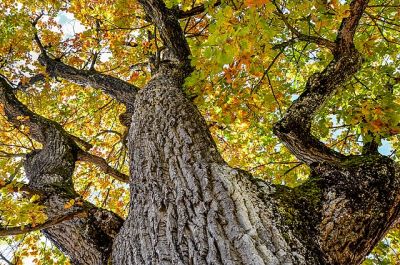
As a boy, he had encountered “many violences,” but the one he kept returning to was the violation of his father’s soul conducted at his funeral. . . . And thus even as a boy, he had to find some “inner resource that could give me enough immunity to the violence of my environment to enable me to have a sense of normalcy and worthwhileness in being a human being.” . . . That’s what the oak tree [in his backyard] provided him; it was his “windbreak against existence.” He could also return there and “talk things over. It was the one thing in our yard that did not give when the seasonal hurricanes came.” (HT, 192)
As Thurman grew up in his home town of Daytona Beach, Florida, the white population changed and became more racist with northern snowbirds being replaced by southern whites. Harvey’s biography describes Thurman’s call to ministry (“I feel the needs of my people” – HT, 18), and his spiritual journey from attending seminary to pastoring churches, studying mysticism with the Quaker scholar Rufus Jones, meeting with Gandhi in India, serving as spiritual mentor to civil rights leaders, and becoming the dean of chapels at Howard and Boston Universities. Thurman’s conversations with Gandhi deepened his commitment to nonviolence as the best response to the violence of racism, a commitment he shared with the more activist leaders of the civil rights movement. From Harvey’s biography:
Thurman related a story from the civil rights movement about a woman who had been pinned to the ground by a policeman but at the moment felt a sense of peace within herself. For him, it was an example of how “nonviolence is the tapping and the releasing of the resources of vitality and energy in the human spirit that make it possible to relax and overcome the spirit of retaliation.” (HT, 207)
This woman’s practice of nonviolence as the “releasing of the resources of vitality and energy” echoes Thurman’s boyhood experience of an oak tree (and other natural phenomena) providing him with an “inner resource that could give me enough immunity to the violence of my environment to enable me to have a sense of . . . worthwhileness in being a human being.”
Thurman’s love of nature was an integral part of a spiritual vision that embraced both environmental and social justice. Like the brutal exploitation of Blacks in slavery, he recognized that nature, too, has been degraded by human exploitation. In his words,
Man is a child of nature; he is rooted and grounded in the earth. He belongs to it, and it belongs to him…Man cannot long separate himself from nature without withering as a cut rose in a vase. One of the deceptive aspects of mind in man is to give him the illusion of being distinct from and over against but not a part of nature. It is but a single leap thus to regard nature as being so completely other than himself the he may exploit it, plunder it, and rape it with impunity. . . . This we see all around us in the modern world. Our atmosphere is polluted, or streams are poisoned, our hills are denuded, wildlife is increasingly exterminated, while more and more man becomes alien on the earth and fouler of his own nest. [1]
According to Beth Norcross,
In Thurman’s works, particularly his later ones, there’s another aspect of nature he returned to often—unity. There was, he believed, “an original harmony” and wholeness within creation. This original harmony included relationships between humans . . . and between humans and the non-human world. This original harmony, however, has been disrupted by the actions and inaction of humans. This broken harmony, he says, is particularly painful and evident to African Americans. For Thurman, our human vocation is, therefore, to rediscover and reclaim the original harmony of creation. To do that, he says, we must first confront the disharmony we have wrought. [2]
Nature can be a source of strength and renewal, like it was for Thurman: “I needed the strength of that tree, and, like it, I wanted to hold my ground. . . . I could talk aloud to the oak tree and know that I was understood.” Thomas Berry had a “magic moment” when as a youth he first viewed a certain “meadow across the creek,” The experience eventually became the lodestar of his intellectual and spiritual life:
This early experience, it seems, has become normative for me throughout the range of my thinking. Whatever preserves and enhances this meadow in the natural cycles of its transformation is good; what is opposed to this meadow or negates it is not good. My life orientation is that simple. It is also that pervasive. It applies in economics and political orientation as well as in education and religion and whatever.[3]
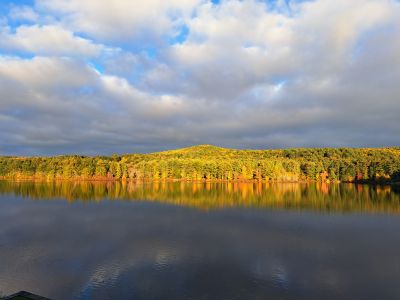
If I were to pick an example of a presence in the natural world that has come to have a special meaning for me, I would pick the one outside a cottage my wife and I live in several months a year: Hardwick Pond in central Massachusetts. The occasions when I’ve sat on our porch quietly looking at the pond and its setting (I call it “pond-gazing”) have given me me glimpses of what Thurman and Berry experienced. The scene before me is, to use a Navajo term, Hózhó, peace, balance, beauty and harmony.
___________________________________________
[1] Quoted in a sermon delivered at St. Paul AME Church on 3/19/16 by Demarius J. Walker. https://gipl.org/blog/thurman-the-disinherited-and-environmental-justice[2]
 Ecozoic Cafe