Our Nation’s Changing Views of Nature: An Exhibition

We love art because we enjoy the beauty of what artists create, but art can also be appreciated as a record of human cultural values and beliefs. An excellent example of this approach is Nature’s Nation: American Art and Environment, an exhibition at the Peabody Essex Museum available through May 5th, which uses art to show the evolving attitudes of Americans of European heritage toward nature and how different they were from those of Native Americans. Rachel Allen, a member of the Nez Perce tribe and one of the exhibition’s Curatorial Fellows, writes:

When you explore this exhibition, I hope you think about your walks, your sphere. What are the artists communicating about our environment? How do these works challenge your ideas about nature? How do you influence the world around you? Can we do better?

Rachel Allen, “Not Separate from Nature,” Peabody Essex Museum, accessed April 18, 2019, https://www.pem.org/blog/not-separate-from-nature

In one of the exhibition’s first display cases, the museum goer can see a traditional Christian depiction of the universe.


The Great Chain of Being from the Rhetorica christiana by Fray Diego de Valades (1579) (Source)

This pictorial version of the universe as a Great Chain of Being was based on “a theory . . . which dominated cosmology from the Middle Ages to the dawn of modernity.”1 In this hierarchical order, spiritual and human realms exist above the creatures of air, sea and land. Below all is the underworld with Satan reigning over the damned. The greater the proximity of a being to the Creator and Ruler of the Universe, the greater its inherent goodness and value. This metaphysical distinction between human and natural worlds in Western thought has deeply influenced much of the Western religious and cultural imagination which sees the natural world as something that can be manipulated and controlled for humanity’s benefit.

In art, examples of early American painting on display in the exhibit include portraiture typical of the period where nature appears in the distance behind the portrait’s human subject as an ornamental background. But by the mid-19th century, painters of the Hudson River School like Thomas Cole (1801-1848) and Albert Bierstadt (1830-1902), inspired by the magnificent vistas they encountered, had introduced a more expansive and romanticized vision of the American landscape. Cole’s Home in the Woods (1847) shows an idealized image of family life available to those eager to move westward into new territories following the 19th-century Manifest Destiny doctrine justifying the nation’s expansion across the American continent.

Home in the Woods, Thomas Cole
Source

Such idyllic scenes, while representing a deep feeling for the land the settlers may have had, were also leaving out quite a bit of the westward expansion story. Near the Cole painting are the following pair of artworks:

My photo

The painting on the left, Bridal Veil Falls, Yosemite by Albert Bierstadt (about 1871-1873) is paired with a 2007 artwork, Fallen Bierstadt by Valerie Hegarty. According to the accompanying gallery text,

Paintings like this one [Bridal Veil Falls] legitimized U.S. land theft and violence against Indigenous people. Hegarty’s Fallen Bierstadt questions the way such traditional landscape painting idealizes nature as an untouched retreat or a tourist spectacle that ignores complex histories and fragile ecosystems.

But throughout the exhibit one encounters examples of a very different artistic imagination like this 19th century robe by a Tinglit artist.

Chilkat Robe by Tinglit artist.
(My photo)

According to an accompanying gallery text, the robe “embodies deeply help beliefs about humans and other beings in a shared environment, and asserts . . . values encompassing the natural world and the wider universe.” In Western art like the Cole painting above, the settlers established themselves and their farms within a pristine wilderness functioning like a theater stage for their activity. In the Tinglit robe, its design of a closely linked pattern of killer whales and human artifacts “vividly expresses Tinglit ideals of community and environmental reciprocity.”

The contemporary non-Native art selected for the exhibition doesn’t provide a new vision of a deeper relatedness between human and natural realms. Rather, it offers a sharp critique of our misuse of the environment like this piece:

Midway: Message from the Gyre (2009) by Chris Jordan.
My photo

The work captures the tragedy of seabirds who feed on the plastic material which forms the Great Pacific Garbage Patch. According to the artist, “Like the albatross, we first world humans find ourselves lacking the ability to discern anymore what is nourishing from what is toxic to our lives and to our spirits.” (From the accompanying gallery text.)

The painting below provides a Native American response to disruptions of their natural environment by non-Native activity:

In and Around These Mountains by Mateo Romero (1999).
My photo

According to the gallery text, Romero (Cochiti Pueblo, b. 1966) has painted a “declaration on the authority of the Pueblo world, achieved through intricate networks of relationships that keep the universe in balance through dance and ceremony.” In the Pueblo belief system, this balance is sustained by their spiritual practices despite being surrounded by a radically different culture. The two worlds of Pueblo ceremonial dancers and the F-15 Eagle fighter seem to be in completely different spatial zones with nothing to bridge the distance between them.

The exhibition’s final section is devoted to an installation marking a particular action which occurred during the 2016 protests on the Standing Rock Reservation, North Dakota. The protests were against the construction of an oil pipeline across water and land sacred to the Standing Rock Sioux Tribe. The face-off between the Water Protectors (Native Americans and their supporters) and the police led the artist Cannupa Hanska Luger (b. 1979, Mandan, Hidatsa, Arikara, Lakota, Austrian, and Norwegian) to create the following installation of video and photos of the Mirror Shield Project.


Photos of drone video. Mirror shields, from Mirror Shield Project, 2016. Drone Concept by Cannupa Hanska Luger. Made by anonymous community members. Masonite, Mylar adhesive paper, and rope. My photos.

According to Luger, the project was inspired by protesters in the Ukraine in 2014 who used mirrors to show the police what they looked like in their full riot gear. It was an appeal to their humanity that had been swallowed by all their armor. Luger adapted the Ukrainian’s approach:

I liked the idea of bringing these mirrored shields to the front line to create a barrier that actually unites rather than separates and remind the riot police that we’re trying to protect water for them and their children as well. So this was a way conceptually to put them on our front line as well and reflect that conversation back.

Karen Kramer. “On Creating Solidarity: Cannupa Hanska Luger.” Peabody Essex Museum, accessed April 18, 2019,
https://www.pem.org/blog/on-creating-solidarity-cannupa-hanska-luger

In the installation area, visitors can view a drone video of protesters holding the mirror shields while walking in a procession which eventually coils into a circle they called a Water Serpent. The purpose of the video was to record the mirror holders practicing making the Water Serpent for the times when police airplanes and helicopters made their daily fly-over. (The video is available for streaming,)

In the weeks since viewing Nature’s Nation, I’ve been thinking about what this exhibition is saying to us, the Americans of European heritage. Given the evidence of climate change and global warming, the exhibition’s claim that we have distanced ourselves from our natural environment is on target. Of course that’s not the case for everyone, but so much of our collective life is governed by decisions made by corporations and industries with negative environmental consequences. If the dominant position of our leaders is that the economy and its metrics like GDP and stock market indices are what determine our society’s well being, then an important factor has been left out of the equation. “The economy and the environment are both two sides of the coin. If we cannot sustain the environment, we cannot sustain ourselves,” said Wangari Maathai, founder of the Green Belt Movement and the 2004 Nobel Peace Prize Laureate.

Our notions of what makes our society healthy and vital must be radically revised. Perhaps indigenous mythologies and cosmologies can inspire us to rethink the ones we have inherited. Thomas Berry has argued that we are require a New Story (see related post). It’s clear from this exhibition of more than 100 pieces art on view in Nation’s Nature that we need new visions of how we are an integral part of the natural world we inhabit.

_________________________________________
1 Maxim Khomiakov. “Hierarchy and Order.” New Dictionary of the History of Ideas, edited by Maryanne Cline Horowitz, vol. 3, Charles Scribner’s Sons, 2005, p. 990.

Posted in Notes | Tagged , , , , | Leave a comment

And how are the children?

Forms of greeting vary around the world. In India, you would say “namaste” and bow. In Ukraine, it’s the triple kiss, left-right-left, etc. Masai warriors in Kenya, even those without children, greet each other with “Kasserian ingera” which translates as “And how are the children?” The usual reply is “All the children are well,” in other words all are safe and peace prevails in my village.

Could we say our children are well? Our initial reaction might be that on the whole, the kids are safe, especially if we compare our situation to countries like Syria, South Sudan, or Yemen where “children are being targeted and exposed to attacks and brutal violence in their homes, schools and playgrounds” (UNICEF press release). But if we reflect on the question more deeply, can we say unequivocally that our kids are doing well?

Studies show that many of our children feel anxious and depressed, although the reasons may not necessarily be related to physical violence. Causes might be parents’ stress and unmet medical needs, but social media and classroom pressures have also been identified as serious sources of anxiety. And unfortunately there are children who live in violent neighborhoods where death is a frequent reality in their daily lives.

Can a larger issue like the worldwide concern about environment degradation be a source of anxiety for children? There’s no lack of opportunity for them to pick up on the tension pervading public conversation about the topic. If they don’t hear about it at home, they will from the media. The news has been filled with headline-making reports like the one published last August by the UN’s Intergovernmental Panel on Climate Change that said crucial policies to reduce global warming must be in place by 2030 to avoid the worst. An intelligent 16 year old can easily understand that at 28, she very well may be facing a global catastrophe.

When I try to imagine what some children might be feeling, I remember having a scary dream as a child about an atomic bomb explosion. It was a time when the possibility of a global catastrophe in the form of a nuclear war hung heavy in the air. At school, teachers periodically would call out “take cover” and we would have to hide under our desks. Novels and films like Fail Safe and On the Beach succeeded in rousing our dread about a worldwide devastation. Might climate change be having a similar effect on children today?

According to one study, based on interviews with fifty children ages 10 to 12:

Findings revealed 82% of children expressed fear, sadness, and anger when discussing their feelings about environmental problems. A majority of children also shared apocalyptic and pessimistic feelings about the future state of the planet. These results suggest that many children are “ecophobic” (i.e., fearful of environmental problems), which scholars argue may have serious implications for children’s participation in environmental stewardship and conservation efforts more broadly. 

Other research studies corroborate these findings, for example this one.

For those of us who might be concerned that the younger generation is disengaged because they feel there’s little they can do, it’s heartening to see that some are taking action. Students around the world have begun skipping school on Fridays as an act of protest. A 16 year old, Greta Thunberg, has become a remarkable spokesperson for her generation, as this TED talk shows. After gaining her nation’s attention by starting the first school strike in Sweden last August, she was invited to address the United Nations Climate Change Conference and later to give a talk to the World Economic Forum at Davos. In Oregon, protest has taken the form of a series of legal suits against the Trump administration. A legal team led by Julia Olson has argued on behalf of 21 young people ages 11 to 22, saying ”We will keep shining light on our fundamental constitutional rights [to life, liberty and property ] until we obtain justice for our children and put an end to U.S.-sanctioned climate change” (source).

If some children are increasingly fearful of the natural world because of global warming’s effects on the environment, we (their elders who have contributed much to the problem) owe it to them and their future to make sure their relationship with the earth is positive and full of love for its wonders. A leader of RiverLink, an organization promoting the environmental vitality of a particular river area in North Carolina “as a place to work, live, and play,” writes:

We are so lucky to live in a place with such beautiful natural resources. It makes sense that we want to do everything we can to protect places like this, and that often includes sharing the environmental burden with our children. However, if we want our kids to thoughtfully and genuinely engage in conservation we absolutely have to give them the space to develop an appreciation for nature first. After that, it’s up to them whether or not they deem it to be something worth fighting for. (Source)

In the same vein, Thomas Berry wrote:

A truly human intimacy with earth and with the entire natural world is needed. Our children should be properly introduced to the world in which they live, to the birds and the insects and the various animals that roam over the land, to the entire range of natural phenomena. . . . (TB, 34)

Tomorrow, March 15, 2019, students around the world will engage in a Climate Strike. May we listen closely to their demands, share with them our love of our beloved planet earth, and pledge to work with them to transform the ways in which we live in relation to the natural world.

Posted in Notes | Tagged , , | Leave a comment

She walked in the world to love it . . .

Landscape near Provincetown, October 2013, © Gerhard Huber (CC BY-NC)

Soon after her death on January 17th of this year, the loving eulogies and appreciations began appearing in the media universe. Whatever critics might think about the plainness of her style (which she consciously aimed for), many readers of Mary Oliver’s works grew to “own” her poems. In her interview with Krista Tippett, Oliver compared poetry to prose: “People are more apt to remember a poem and therefore feel they own it and can speak it to themselves as you might a prayer.” At another point during that interview, Oliver showed how writing a particular poem (one of her more famous) was an exercise in the craft of poetry:

MS. TIPPETT: “Wild Geese” is in Dream Work, and I’ve heard people talk about that, “Wild Geese,” as a poem that has saved lives. And I wonder if when you write something like that — I mean, when you wrote that poem or when you published this book, would you have known that that was the poem that would speak so deeply to people?
MS. OLIVER: This is the magic of it. That poem was written as an exercise in end-stopped lines.
MS. TIPPETT: As an exercise in what?
MS. OLIVER: End-stopped lines. Period at the end of the line. I was working with a poet. I had her in a class.
MS. TIPPETT: So it was an exercise in technique. [laughs]

Oliver, who lived and wrote for five decades in Provincetown, Massachusetts on Cape Cod, was often aptly described as a nature poet because of the many wonderfully detailed natural images that appear in her poems like the following lines from “The Summer Day:”

Who made the grasshopper?
This grasshopper, I mean-
the one who has flung herself out of the grass,
the one who is eating sugar out of my hand,
who is moving her jaws back and forth instead of up and down-
who is gazing around with her enormous and complicated eyes.
Now she lifts her pale forearms and thoroughly washes her face.
Now she snaps her wings open, and floats away.

Close observation of and listening to the natural world was her preferred way of life.

The Old Poets of China

Wherever I am, the world comes after me.
It offers me its busyness. It does not believe
that I do not want it. Now I understand
why the old poets of China went so far and high
into the mountains, then crept into the pale mist.

Wandering the Provincetown landscape was Oliver’s version of slipping into the mountain mist.

It’s interesting to note that Oliver’s poems are deeply appreciated by believers across religious traditions. Here are Christian, Buddhist, and Jewish examples. But she is also beloved by people who consider themselves spiritual but not religious (see for example the eighth commandment on this page). Given that her poetic vision is rooted in her love of the natural world, her poems are being read like a prayer book of an earth-centered spirituality.

United Church of Christ minister and seminary professor Thomas W. Mann believes that Oliver’s poetry is to be read as “the Other Book of God,” the Book of Nature that a number of Christian spiritual teachers since the early church have regarded as a second scripture alongside the Bible. Mann quotes St. Anthony the Great (251-356 bce): “My book is the nature of created things, and as often as I have a mind to read the words of God, they are at my hand” (GD, xiii). And for Mann, her poetry is an essential resource for our times:

Before any attempt to address the problems of environmental degradation, however, we must undergo a change of consciousness. We must come to a new sense of the sacredness of the earth under our feet and the sky over our heads. We must come to the humble awareness that we humans are only one part of “the family of things.” We must experience a new vision of the beauty of the world. That is why we so desperately need the artists among us.

“I am a performing artist,” Oliver says. “I perform admiration. / Come with me, I want my poems to say. And do the same.” That is exactly what we intend to do. (GD, xv)

Tippett’s 2015 interview with Mary Oliver is available as a podcast and transcript. I highly recommend it. May you come to “own” some of her poems if you haven’t already.


Note: The post’s title was inspired by Mary Oliver’s statement in one of her essays: “I walk in the world to love it” (LL, 40).

Posted in Notes, Poems | Tagged , | 2 Comments

Moments of Grace

Christmas Revels, Washington DC
Source

Those of us in the Northern Hemisphere have recently experienced the longest night of the year. A few nights later, many of us celebrated the birth of Jesus, Son of the Creator, whose coming was signaled by an astronomical sign. It was a time for recognizing the wonderful mystery of our human existence within the larger reality of the cosmos. Observances of the winter solstice around the world include song, dance, and festive meals. During Christmas Eve church services, Christians sing their beloved Christmas hymns, but then some church goers may also join others in an ostensibly more secular setting to enjoy the singing, dancing, and story-telling of a Christmas Revels performance or a magical production Tchaikovsky’s Nutcracker ballet.

The near concurrence of the two events suggests a historical relationship. Many citizens of the Roman Empire celebrated winter solstice, calling it dies solis invicti nati (“day of the birth of the unconquered sun”). Some historians argue this to be the reason Christians selected a similar date. However, this theory is not universally accepted and other explanations have been proposed. Whatever the historical reason for selecting December 25th as Christ’s birthday, many people today celebrate both events. Could it be because there’s a basic human desire to praise the mystery of existence in both its human and cosmic manifestations?

Thomas Berry thinks that the human connection to the natural world was more intimate in the past, that we have become more removed from the rhythms of the earth and sky.

All human occupations and professions must themselves be expressions of the universe and its mode of functioning. This is especially true of what came to be known as religion, . . . Earlier peoples seem to have understood this. They lived in a pattern of human activities that were validated by their relation with the cosmological sequence. . . .

With regard to time and seasons, rituals were established to create a consciousness of the moments of cosmological change: the dawn and dusk of the daily sequence of sunlight and darkness, the increase and decline in the phases of the moon, the winter solstice especially as the danger moment of the universe, the period of dark descent; then came the rise into the world of warmth and light and the blossoming of the plants and the birth and the birth moment of the mammalian world. . . . Such moments were moments of grace, moments when the sacred world communicated itself to the world of the human. (TB, 52-53)

Thankfully, we can sometimes encounter such moments in poems or songs like Wintergrace by Jean Ritchie . . . 

 . . . or when a community decides to have a celebration like the one that happened near me in Roslindale, Massachusetts:

. . . or when the Christmas Revels performers come down off the stage while singing Lord of the Dance to start a large circle of audience members dancing:

Posted in Notes | Tagged , , | Leave a comment

Teilhard in the Trenches

A few weeks ago, people around the world observed the 100th anniversary of the end of hostilities in World War I, one of humanity’s most devastating conflicts with 8.5 million deaths, 21.2 million wounded, and 7.6 million missing. When the war began in August 1914, Teilhard de Chardin had been studying, teaching, and conducting research for over ten years. (See An Ocean of Matter, Cynthia Bourgeault on Teilhard, and It’s All about Seeing for my earlier posts introducing Teilhard’s thought.) His decision to serve in the military as a stretcher bearer instead of an officer and chaplain brought him into close daily contact with his fellow soldiers who were enlisted Zouaves and Moroccans. Teilhard’s courageous service earned three medals for his valor, but he also made a deep spiritual impression on his regimental comrades who called him Sidi Marabout, a religious teacher or holy man.

Teilhard, on the right, at Verdun. (Source)

While his involvement in the war must have been incredibly demanding on his inner life and physical energy, Teilhard continued to develop his understanding of evolution, in particular his idea of the Noosphere, a third layer of thought emerging from the preceding biological layer of life (Biosphere) and life’s underlying stratum of the the earth’s crust and core (Geosphere). Immersed in dealing with the tragic consequences of large numbers of human beings engaged in deadly combat, he nevertheless was moved by the intensity of what he saw: “’The ‘Human-Million,’ with its psychic temperature and its internal energy, became for me a magnitude as evolutively, and therefore as biologically, real as a giant molecule of protein.” If life as the Biosphere formed a “living membrane” over the earth’s surface, then

. . . around this sentient protoplasmic layer, an ultimate envelope was beginning to become apparent to me, taking on its own individuality and gradually detaching itself like a luminous aura. This envelope was not only conscious but thinking, and from the time when I first became aware of it, it was always there that I found concentrated, in an ever more dazzling and consistent form, the essence or rather the very Soul of the Earth. (HM, 31-32)

Calling this sentient layer the Noosphere, Teilhard began to discern the details of the process by which this “ultimate envelope” had emerged. The metaphors of heat and fire helped Teilhard describe the emergence of life and thought out of matter as if through a chemical reaction. The reaction takes place within the “planetary crucible,” another metaphor involving fire that appears elsewhere in his writings. The chief ingredient of the reaction is the crucible itself, i.e., Matter, and the product is Spirit: “Matter is the matrix of Spirit. Spirit is the higher state of Matter.”

Having realized that a Noosphere (or Soul of the World) exists, and that it emerges from Matter, Teilhard concluded that this layer, like the physical layers before it, followed an evolutionary course which he called Noogenesis. The earth’s evolution has advanced to the level of “a rapidly rising collective Reflection,” a development so obvious “that we cannot but recognize the objective, experiential reality of a directionally controlled transformation of the Noosphere as a whole.”

This transformation is following an irresistible process of convergence toward a “final critical point.” The goal of Noogenesis is the Omega: “The ‘piece of iron’ of my first days has long been forgotten. In its place it is the Consistence of the Universe, in the form of the Omega Point that I now hold, concentrated (whether above me or, rather, in the depths of my being, I cannot say) into one single indestructible center, which I can love (HM, 39).” And this center can be loved because it is a personal reality: the Christ “in [whom] all things hold together”(Col. 1:17).

Surrounded by the horror of war, Teilhard nevertheless arrived at an extraordinarily hopeful vision of humanity’s future. But I struggle to understand how he could come up with such a positive view despite being immersed in the suffering he encountered every day carrying out his duties. His spirituality must have been an incredible source of strength.

Posted in Notes | Tagged , , | 1 Comment

Gratitude for our “little blue marble”

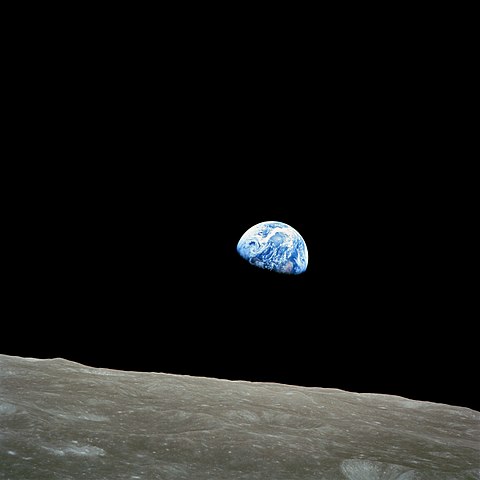
Fifty years ago, Apollo 8 was launched as the first manned spacecraft to leave Earth orbit in order to circle the moon. Astronauts Frank Borman, Bill Anders, and James Lovell had an extensive list of tasks to perform during the flight which would inform future space flights like Apollo 11’s moon landing the following year. They successfully fulfilled their mission which included taking photos of the lunar surface, but they also returned with a photographic image taken as an unplanned spontaneous reaction to the spectacular view unfolding before them as their space module rounded the moon. Taken by Bill Anders on Christmas eve, the photo would become a worldwide sensation known as Earthrise.

Filmmaker Emmanuel Vaughan-Lee has created a 30 minute documentary to mark the 50th anniversary of the flight and the making of the iconic photo. Told by the astronauts themselves who were interviewed by Vaughan-Lee, the film includes archival footage of their activities inside the capsule as well as the changing views outside the capsule’s windows. Here is an article by Vaughan-Lee about the making of the film with a link to the documentary.

Watching the film, I was taken by the way they were all deeply affected by the experience of seeing “the little blue marble” rise above the moon’s horizon. “We were all awestruck” says one. On this day of thanksgiving, I want to give thanks for their accomplishment, the image they brought back – an icon of oneness of all life on this little planet, and the earth itself, our beautiful home.

Posted in Reflections | Tagged | Leave a comment

Hemlock Hospice

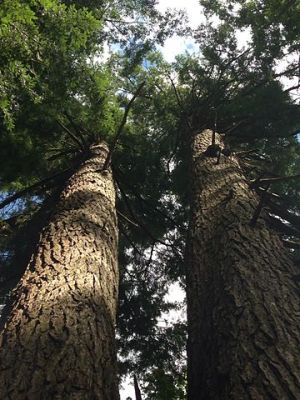
Until recent years, eastern hemlock trees (tsuga canadensis) have been an enduring presence in our cultural and natural environments. Hemlocks can grow for hundreds of years to more than 150 feet tall on trunks measuring six feet in diameter. They appear in poems by Robert Frost and Emily Dickinson. Forestry scientists will tell you that hemlocks are a foundation species which “define forest structure and . . . control ecosystem dynamics.” Pennsylvania designated it as the state tree and its page about its symbolism quotes A. J. Downing, “the father of landscape gardening in America,” as declaring the hemlock to be “the most picturesque and beautiful of the world’s evergreens.”

However, because of the hemlock wooly aldegid (HWA), an aphid-like insect native to East Asia and about 0.8 mm. in length, eastern hemlocks are disappearing in forests from northern Georgia to southwestern Nova Scotia. A 2015 alert from the National Park Service reported that as many as 80 percent of eastern hemlocks in Shenandoah National Park had died. A sad development for Bostonians, Hemlock Hill in Boston’s Arnold Arboretum is completely infested.

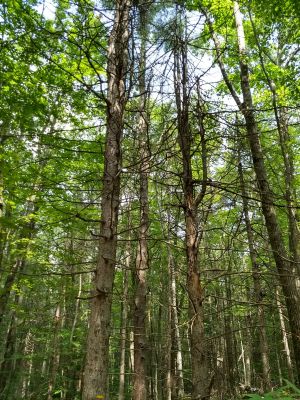
hemlockstand2

Stand of Hemlocks in Harvard Forest

[Note regarding this photo: Most of the eastern hemlocks in Harvard Forest are younger, hence thinner and shorter, than the giants shown in the first photo. That’s because a storm called the Great Hurricane of 1938 felled 70 percent of the standing trees in Connecticut, Massachusetts, and New Hampshire when it blew through the region.]

Scientific organizations around the globe are monitoring forests to identify critical factors behind dramatic changes in their composition and overall health. One such group is The Harvard Forest, a department of the Faculty of Arts and Sciences of Harvard University founded in 1907 in Petersham, Massachusetts. It includes a center located on 4,000 acres of land where scientists, students, and collaborators explore physical, biological, and human systems affecting the surrounding forest. An important part of its mission is to educate students and the general public about how these systems are changing over time. Scientists looking for causes of the eastern hemlocks’ dying have gathered data which point to global warming as the culprit. Aldegid mortality is 90% at 4 degrees below zero Fahrenheit which of course increases with even colder temperatures, but the area around Harvard Forest hasn’t been cold enough for at least a decade to keep the WHA at bay. Given this fact, the spreading demise of the eastern hemlock serves as a marker of climate change’s advance up the Atlantic seaboard as higher average temperatures become more common in the northern states.

When the Harvard Forest team recognized there was an urgent need to communicate this bad news to the public, they decided to combine art and science in a visual project that could both increase awareness and invite personal reaction. The result was Hemlock Hospice, a year-long interpretive trail through dead and dying stands of hemlocks along with twelve art installations by David Buckley Borden, Aaron M. Ellison and a group of interdisciplinary collaborators. It’s a great example of how artists, designers, and scientists can work together to enable us to see nature in the process of dramatic change.

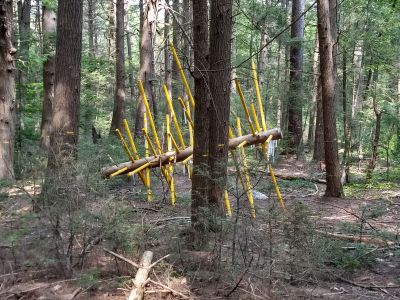
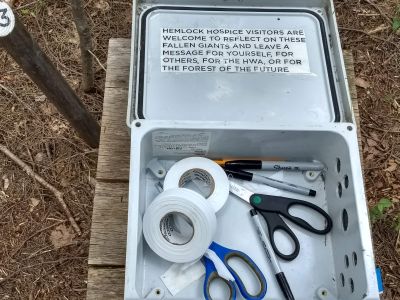
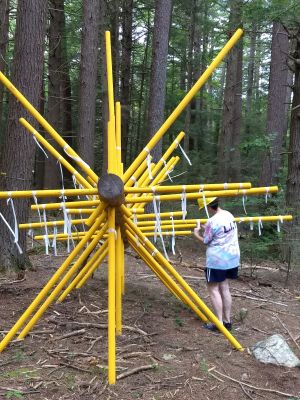
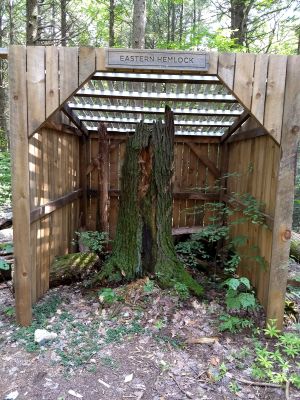
I imagine that people’s reaction to the Hemlock Hospice varies from simple curiosity to deep sadness. Aaron Ellison, one of the creators behind the Hemlock Hospice project, experiences grief: “As a scientist, I study how our forests may respond to the loss of this ‘foundation’ tree species. As a human being, I cry, I mourn, and I look to the future of hope.” (Quoted on the WLA blog.) I found two of the installations particularly moving: the Hemlock Memorial Shed and the Exchange Tree. The Shed harbored a hemlock’s broken trunk. The Exchange Tree, modeled after a nearby fallen hemlock, had yellow dowels for branches from which reflections written on cloth tape could be hung. Both were like sacred shrines created to mark a beloved’s passing. Standing before them, I couldn’t help but reflect, meditate, pray.

[The photos below were taken during my and my wife Katie Lee’s visit last August.]

hemlock sign2

hwabuzzsaw2

“HWA Buzzsaw”

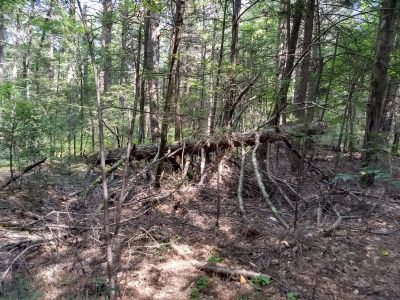
fallenhemlock2

Fallen hemlock

fallenhemlockart2

Exchange Tree

reflectionkit2

KThemlock

Leaving a reflection

hemlockmemorialshed2

Hemlock Memorial Shed

Posted in Notes | Tagged | Leave a comment

The Patron Saint of Ecologists

October 4th is Saint Francis’ feast day, but the weeks of late September and early October might as well be Francis’ feast month. On any given Sunday during this period, people in many denominations bring their pets to church to be blessed by clergy in the name of the beloved saint. Therefore, when Pope John Paul II in 1979 declared Francis of Assisi (1182– 1226) the patron saint of ecologists, the saint’s new assignment seemed like a perfect fit. Already a patron saint of Italy along with Catherine of Siena, this additional tribute was the result of a happy confluence of Francis’s love of nature and a growing scientific interest in the environment. It’s interesting to note, however, that the Pope’s declaration was preceded by a medieval historian’s similar proposal. In a 1967 article appearing in the research journal Science, the historian Lynn White argued that Christianity has to bear a significant part of the blame for the ecological crisis:

Since both science and technology are blessed words in our contemporary vocabulary, some may be happy at the notions, first, that, viewed historically, modern science is an extrapolation of [Christianity’s] natural theologyand, second, that modern technology is at least partly to be explained as an Occidental, voluntaristrealization of the Christian dogma of man’s transcendence of, and rightful mastery over, nature. But, as we now recognize, somewhat over a century ago science and technology – hitherto quite separate activities – joined to give mankind powers which, to judge by many of the ecologic effects, are out of control. If so, Christianity bears a huge burden of guilt. (HR, 1206)

According to White, Francis has an important role to play in reorienting our Western attitude toward God’s creatures.

Possibly we should ponder the greatest radical in Christian history since Christ: Saint Francis of Assisi. . . . The key to an understanding of Francis is his belief in the virtue of humility not merely for the individual but for man as a species. Francis tried to depose man from his monarchy over creation and set up a democracy of all God’s creatures. With him the ant is no longer simply a homily for the lazy, flames a sign of the thrust of the soul toward union with God; now they are Brother Ant and Sister Fire, praising the Creator in their own ways as Brother Man does in his. (HR, 1206)

White concluded the essay with his proposal which he offered as a religious response to the ecological crisis.

Both our present science and our present technology are so tinctured with orthodox Christian arrogance toward nature that no solution for our ecologic crisis can be expected from them alone. Since the roots of our trouble are so largely religious, the remedy must also be essentially religious, whether we call it that or not. We must rethink and refeel our nature and destiny. The profoundly religious, but heretical, sense of the primitive Franciscans for the spiritual autonomy of all parts of nature may point a direction. I propose Francis as a patron saint for ecologists. (HR, 1207)

According to data available in the Web of Science, the widely used citation indexing service for scholarship in the humanities, social and physical sciences, White’s article has been cited in over 1,400 articles and books. In other words, White’s views about “Christian arrogance over nature” have received a great deal of attention. But White’s criticism of Christian scripture and theology has in recent decades been challenged by theologians who point to a rich theological tradition that recognizes nature’s deep relationship with the divine. It’s a tradition where Saint Francis is not an isolated figure but an exemplar within a theological school of thought based on scripture and Greek theologians of the early church. An excellent summary of some of the main threads of this school can be found in an article by Keith Warner, OFM. He begins by acknowledging the flaws in Christian ethics regarding the ecological crisis:

The field of Christian environmental ethics emerged in response to the provocative yet flawed thesis of Lynn White, and it retained a defensive posture for its early years. The field has struggled to find a compelling and coherent moral narrative that embraces the Christian story and care for the Earth. (FE, 143)

Warner argues that a “compelling and coherent narrative” could start by mining the rich theological resources of the Franciscan tradition.

Drawing its inspiration from the love Francis of Assisi had for nature, the Franciscan tradition holds that creation bursts with religious significance. This tradition interprets Francis’s affective and direct sensory experience of the natural world with theological concepts drawn creatively and reworked from scripture and patristic sources, especially on the Incarnation and the Trinity. Of course, medieval Franciscans were in no way addressing environmental degradation or pollution. However, their work can prompt us to retrieve ancient theological currents to inform contemporary applications as a useful ethical method for duties toward the environment. (FE, 145)

Medieval Franciscan theologians Bonaventure (1221 – 1274) and Duns Scotus (1266 – 1308) are often considered as two of the three greatest theologians of their era, the third being the Dominican friar Thomas Aquinas (1225 – 1274). At a time when Francis was still vividly remembered by many, Bonaventure wrote the saint’s biography incorporating many of the stories being told about him. Here’s an excerpt from Bonaventure’s The Life of Saint Francis of Assisi (Legenda Maior):

In beautiful things he beheld Beauty itself
and through the footprints impressed in things
He followed his Beloved everywhere,
Out of them all things making for himself a ladder
Through which he could climb up to lay hold of him
who is utterly desirable.
With an intensity of unheard devotion, he savored
in each and every creature—as in so many rivulets—that fountain of Goodness
and discerned an almost celestial choir in the chords of power and activity
given to them by God, and like the prophet David,
he sweetly encouraged them to praise the Lord. (FE, 149)

That praise is most famously expressed in his Canticle of the Creatures, known also as The Canticle of Brother Sun, a psalm-like hymn that has been adapted and set to music by Paul Winter for his Missa Gaiaby William H. Draper in the Anglican hymn All Creatures of Our God and King, and by many others. Here is a translation from a Franciscan website:

The Canticle of Brother Sun

Most High, all powerful, good Lord,
Yours are the praises, the glory, the honor,
and all blessing.

To You alone, Most High, do they belong,
and no man is worthy to mention Your name.

Be praised, my Lord, through all your creatures,
especially through my lord Brother Sun,
who brings the day; and you give light through him.
And he is beautiful and radiant in all his splendor!
Of you, Most High, he bears the likeness.

Praise be You, my Lord, through Sister Moon
and the stars, in heaven you formed them
clear and precious and beautiful.

Praised be You, my Lord, through Brother Wind,
and through the air, cloudy and serene,
and every kind of weather through which
You give sustenance to Your creatures.

Praised be You, my Lord, through Sister Water,
which is very useful and humble and precious and chaste.

Praised be You, my Lord, through Brother Fire,
through whom you light the night and he is beautiful
and playful and robust and strong.

Praised be You, my Lord, through Sister Mother Earth,
who sustains us and governs us and who produces
varied fruits with colored flowers and herbs.

Praised be You, my Lord,
through those who give pardon for Your love,
and bear infirmity and tribulation.

Blessed are those who endure in peace
for by You, Most High, they shall be crowned.

Praised be You, my Lord,
through our Sister Bodily Death,
from whom no living man can escape.

Woe to those who die in mortal sin.
Blessed are those whom death will
find in Your most holy will,
for the second death shall do them no harm.

Praise and bless my Lord,
and give Him thanks
and serve Him with great humility.

Amen.
__________________________________________

1Natural theology: theology or knowledge of God based on observed facts and experience apart from divine revelation.

2I think White’s use of “voluntarist” in this context refers to the theological doctrine where human action is identified with God’s will. In other words according to White, Christians believed it was God’s will that humanity rule over nature.

Posted in Music, Notes | Tagged , , , | 1 Comment

“Something we’re just learning how to see”

When I take a walk in the woods, I’m entering a complex ecosystem of trees, shrubs, ferns, insects, birds, in other words a dynamic community of a variety of life forms. Like the research participants walking through green spaces in the study described in my previous post, I feel meditative and more open to observing the life around me. But I wonder: Am I also really tuning into the communal activity that surrounds me? I suspect that I’m missing an amazing level of relationship among flora and fauna that escapes my usual means of perception. Here’s an excerpt from a recent novel, The Overstory by Richard Powers (highly recommended), that describes the activity beneath my feet as I move among the trees and shrubs:

Something marvelous is happening underground, something we’re just learning how to see. Mats of mycorrhizal cabling link trees into gigantic, smart communities spread across hundreds of acres. Together, they form vast trading networks of goods, services, and information. . . .

There are no individuals in a forest, no separable events. The bird and the branch it sits on are a joint thing. A third or more of the food a big tree makes may go to feed other organisms. Even different kinds of trees form partnerships. Cut down a birch, and a nearby Douglas-fir may suffer. . . .

In the great forests of the East, oaks and hickories synchronize their nut production to baffle the animals that feed on them. Word goes out, and the trees of a given species – whether they stand in sun or shade, wet or dry – bear heavily or not at all, together as a community. . . .

Forests mend and shape themselves through subterranean synapses. And in shaping themselves, they shape, too, the tens of thousands of other, linked creatures that form it from within. Maybe it’s useful to think of forests as enormous spreading, branching, underground super-trees. (TO, 218)

This two minute video from the BBC provides similar information:


Thomas Berry wants us to see this “Wood Wide Web” as a community based on relationships between living beings, not a random tangle of things:

In the emerging Ecozoic era, we experience the universe as a communion of subjects, not a collection of objects. We hear the voices of all the living creatures. We recognize, understand, and respond to the voices of the crickets in the fields, the flowers in the meadows, the trees in the woodlands, and the birds all around us; all of these voices resound within us in a universal chorus of delight in existence. (TB, 76)

Patricia Westerford, Powers’ fictional botantist in The Overstory (quoted above), is passionate about introducing people to the “something marvelous” that “is happening underground.”  In future posts, I’ll explore what scientists are eager to tell us about the natural world: all those “somethings” in this “universal chorus of delight in existence” we’re just learning how to see.

Posted in Notes, Reflections | Tagged , | Leave a comment

A Walk in the Woods

“I think that I cannot preserve my health and spirits, unless I spend four hours a day at least—and it is commonly more than that—sauntering through the woods and over the hills and fields, absolutely free from all worldly engagements.” ~ Henry David Thoreau, “Walking,” The Atlantic, June 1862. Republished online.

path1

Many of us will agree with Thoreau that a walk through nature can have a wonderfully restorative effect. Some doctors have even prescribed it as a way of reducing stress and increasing a sense of well-being. (See this article for more about “forest therapy” and the Japanese practice of “forest bathing.”). What are the causes of this beneficial experience? The beauty of the natural environment? The silence of the forest (underscored by birdsong and the rustling of trees) compared to our usual noisy soundscape? It’s hard to argue with audio ecologist Gordon Hempton who says that silence is hard to come by these days – it’s like an endangered species. (Krista Tippett interviews Hempton on her On Being podcast.)

Scientists have only recently been able to observe what actually happens within our brains while we take a walk in the woods. Brain wave measurements or cognitive tests in a variety of experiments have shown beneficial effects of being engaged with nature, for example a greater calm, a meditative state of mind, or an improved ability to concentrate. But there hasn’t been a way of capturing brain wave data while we are taking that walk. That changed with the development of a wearable version of the electroencephalogram (EEG), an instrument that collects brain wave patterns. This version of an EEG enabled researchers to conduct a study where the brain waves were recorded of a group of participants walking through three different types of areas, one of which was a “green space.” The results of the study published in The British Journal of Sports Medicine “showed evidence of lower frustration, engagement and arousal, and higher meditation when moving into the green space zone; and higher engagement when moving out of it.” I can’t help but smile whenever science with its carefully methodical approach simply confirms what we know to be true from experience. (I take the report’s meaning of engagement to be the same as Thoreau’s “worldly engagements.”) A summary of this study titled “Easing Brain Fatigue with a Walk in the Park” appeared in the New York Times.

More of us live in cities than ever before. At the same time, popular journals and magazines carry articles about ways to cope with stress, anxiety, and depression. Might an environment composed of mostly concrete and glass cause these psychologically negative states? To find out if there are any causal links, psychologists and other scientists are engaged in the relatively new science of urban stress. (See, for example, this article in the research journal Nature.)

Some city-dwellers are turning to meditation, yoga, tai-chi, and other practices that offer ways of creating a more balanced and peaceful space in their lives. As mentioned above, another path for dealing with stress has been forest therapy or forest bathing. Its success has led to the formation of a professional organization for forest therapists as well as the availability of consulting services. Clearly this approach is meant for people who have lost their ability to connect with nature on their own or never had any such ability, the latter case perhaps more true of people who grew up in the city. All the more reason to take seriously Thomas Berry’s thoughts about the need for people to be introduced to nature at an early stage in their lives, especially children being raised in an urban environment:

A truly human intimacy with Earth and with the entire natural world is needed. Our children should be properly introduced to the world in which they live, to the trees and grasses and flowers, to the birds and the insects and the various animals that roam over the land, to the entire range of natural phenomena. . . . (TB, 34)

The photo at the top of this post is from Harvard Forest. Located in Petersham, Massachusetts, its mission is “to develop and implement interdisciplinary research and education programs investigating the ways in which physical, biological and human systems interact to change our earth.” City born and raised, I have a lot to learn about the natural world and so was truly grateful to learn what its various educational materials had to offer on recent visits. But even without a deeper knowledge of forest ecology (for example, unable to name or say anything intelligent about the flora around me), I have always enjoyed a walk in the woods, be it in a park or the countryside, thankful for its gifts of quiet and moments of reflection.

Given the recent surge of interest in the scientific study of trees and forests (e.g., the popularity of The Inner Life of Trees), I will do a bit more exploring in future posts about their potential role in our spiritual lives.

Posted in Notes | Tagged , , , , , | Leave a comment